Journal — 2026
The Story Behind La Méduse
How La Méduse came to life.
For almost two hours, I stood in front of an aquarium in Crete, watching the jellyfish move.
I was fascinated by the simplicity of their movement. Their bodies opened and closed slowly, carrying them through the water without any visible effort. Their tentacles followed behind them, changing shape continuously, yet always remaining part of the same calm rhythm.
They seemed fragile, but they were not weak. They appeared almost transparent, yet their presence was impossible to ignore. Light passed through their bodies rather than simply falling upon them, making them feel less like solid creatures and more like moving volumes of light.
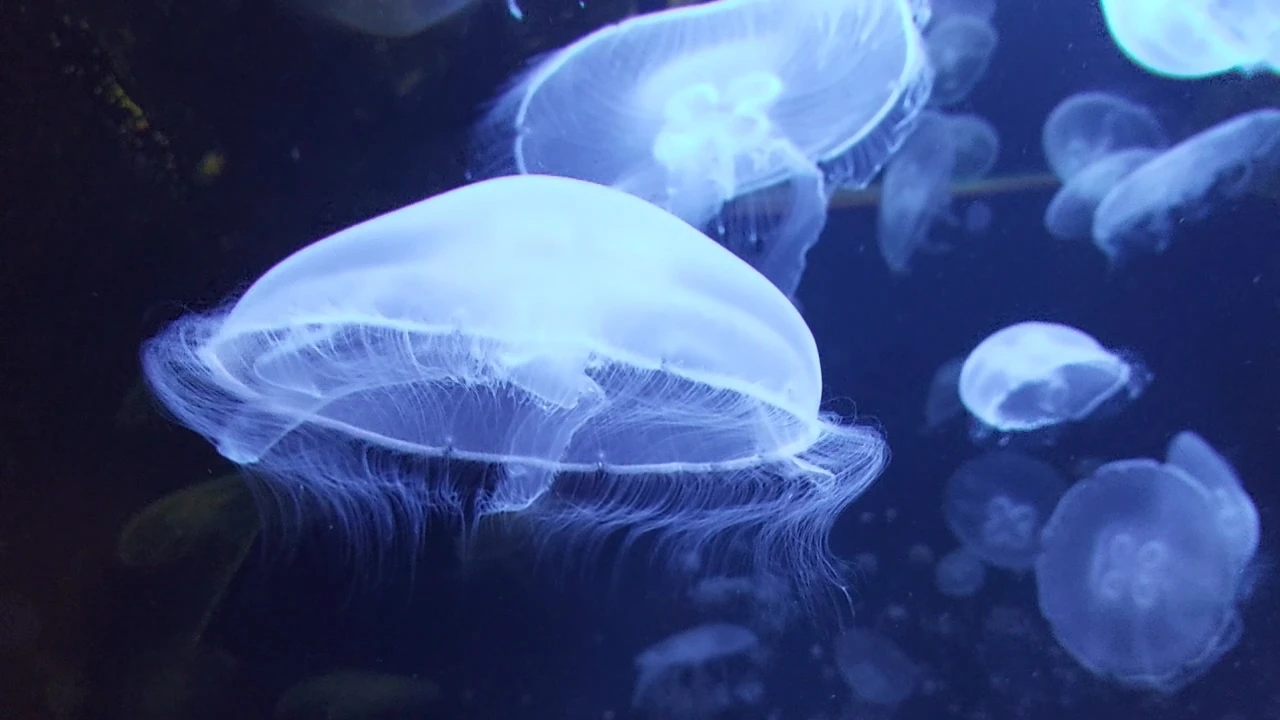
I did not stand there thinking about design. I was not searching for an idea, and I did not imagine that what I was seeing would eventually become a lamp.
I was simply observing.
But some images remain with us without asking for permission.
After leaving Crete, I continued to remember that movement. Not constantly, but often enough for me to understand that something about it had affected me. I remembered the silence of the aquarium, the darkness around the glass and the illuminated bodies moving slowly through the water.
For almost two years, that image remained somewhere in my mind.
During that time, I made no serious attempt to transform it into an object. I did not want to begin by drawing the outline of a jellyfish and turning it into a lamp. A literal imitation would have captured its appearance, but not what had made the experience so memorable.
What stayed with me was not simply the shape.
It was the relationship between form, movement and light.
The jellyfish had no hard separation between its different parts. Its body seemed to continue naturally into its tentacles. Every movement affected the whole creature. Nothing felt attached, decorative or unnecessary.
There was structure, but it did not appear rigid. There was repetition, but no two lines were identical. There was symmetry, but also the quiet irregularity that makes natural forms feel alive.
When I finally began designing La Méduse, I tried to work from that memory rather than from an image.
Two years, compressed: from the first sketches to the finished form.
I wanted to create an object that appeared light, even though it was standing firmly on the ground. I wanted its body to glow from within and its lower elements to feel like a natural continuation of the illuminated form above them.
The upper volume gradually developed into a translucent bell. Its surface softens the light, allowing the entire form to become luminous rather than exposing a single source of illumination.
Beneath it, the slender legs descend and gently change direction. They support the lamp, but I did not want them to look merely structural. I wanted them to retain something of the movement I had observed in Crete — as though they were still responding to water that was no longer there.
The process was not about reproducing the anatomy of a jellyfish. It was about translating a sensation into an object.
I wanted La Méduse to feel calm, but not static. Familiar, but slightly strange. Sculptural, but never heavy.
When the lamp is switched off, its form remains present through its silhouette, its proportions and the rhythm of its legs. When it is illuminated, its character changes. The light reveals the translucent body, softens its edges and gives the impression that the object is quietly alive.
This transformation was important to me.
A lamp should not be only an object that contains a bulb. Light can alter the way we understand form. It can make a surface disappear, reveal an internal structure or change the atmosphere around an object entirely.
With La Méduse, the light does not feel separate from the form. It becomes part of its body.
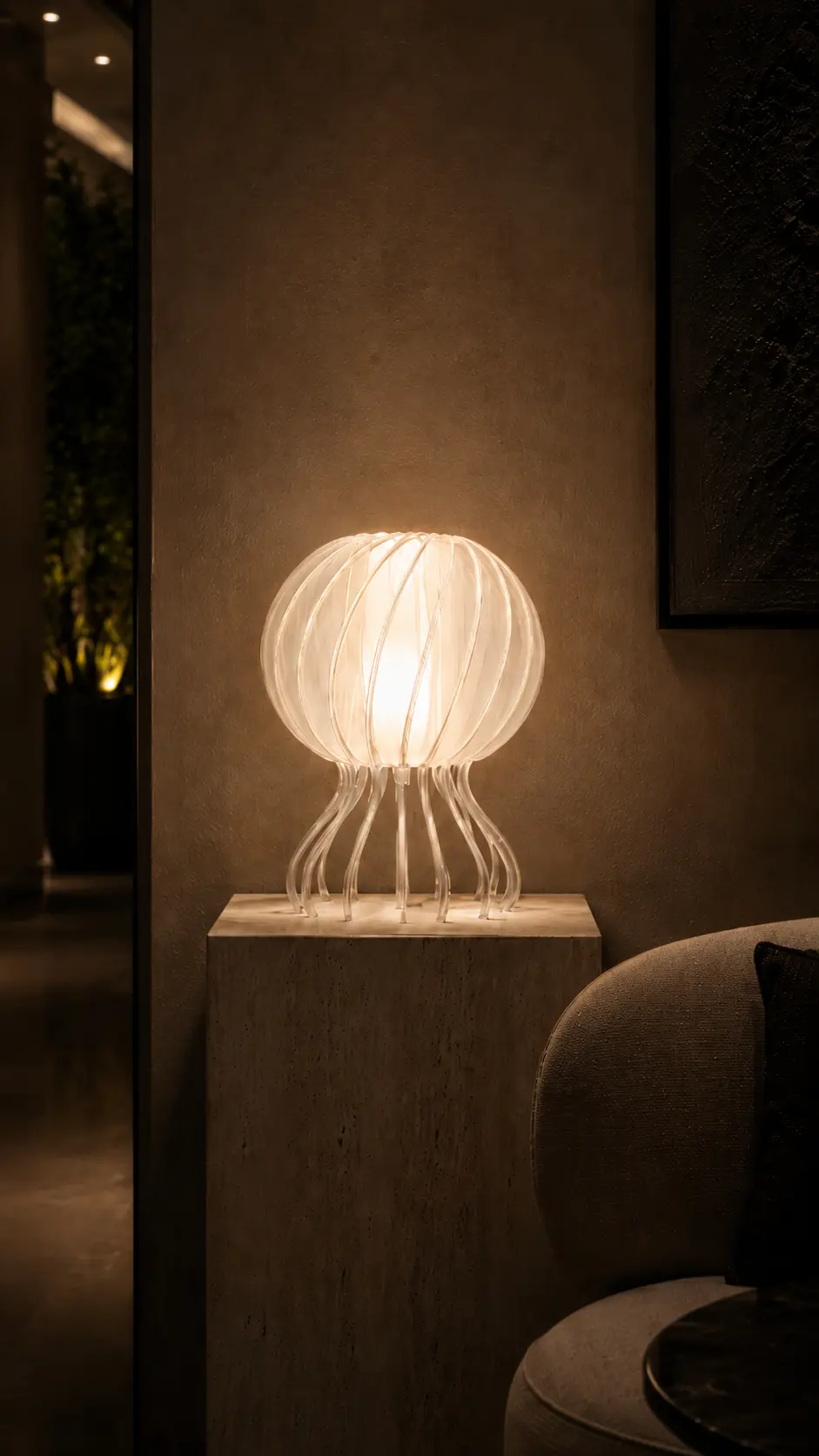
Looking at the finished lamp, I can still recognise the moment that began it. I remember standing in the darkness of the aquarium, watching the jellyfish appear and disappear through the illuminated water.
What began as two hours of observation remained with me for two years before becoming an object.
La Méduse is not a copy of what I saw.
It is the memory of that encounter — the silence, the movement and the light — given form.
— Harry Konstantinou, IDEA34