Journal — 2026
The C Bench
The C Bench began with a phone call.
My friend John was planning to revive an urban forest in Patras, and he asked me to design a bench for it. He called me from the boat, just after leaving Patras for Ithaca.
It sounded like a simple request. A bench for a forest.
But for me, it touched something that had been frustrating me for years.
I was tired of seeing straight benches forced into curved places.
The same rigid object appeared again and again in parks, gardens, squares and landscapes shaped by movement. Paths turned. Trees leaned. Branches bent. The ground rose and fell. And in the middle of all that natural fluidity, someone would place a straight bench, as though the object had no obligation to listen to its surroundings.
It annoyed me deeply. Not because a straight line is always wrong, but because it had become automatic. Nobody seemed to question it. A bench was expected to be straight simply because benches had always been straight.
I could not accept that.
There are almost no straight lines in nature. Rivers turn. Roots spread unpredictably beneath the soil. Coastlines curve. Branches reach towards light without following a ruler. The human body itself is made of transitions, bends and continuous surfaces.
So why should a bench designed for a forest arrive as a rigid interruption?
John’s boat was moving away from Patras while I began sketching.
The first line became a curve. Then the curve became a C.
It happened almost immediately, but it did not feel accidental. The form seemed to contain everything I had wanted to challenge.
A conventional bench places people next to one another in a straight row. Their bodies remain parallel. They look in the same direction. They may share the same seat, but they do not necessarily share a moment.
That had always troubled me too. Why create an object for people and arrange them in a way that makes connection less likely?
The curve was not decoration. It was social. It was a way of bringing people closer without instructing them to come closer.

The C changed that. Its curve gently turned people towards one another. It created the possibility of eye contact. Conversation could begin without effort. The people sitting on it would no longer be arranged like isolated figures in a line. They would become part of a small circle.
I also refused to design the bench as a seat placed on top of separate legs. I wanted the entire object to feel continuous, as though it had grown from one movement.
The surface of the seat would flow downwards and become its own support. The legs would not be attached beneath the form; they would emerge from it. One line would become another. Nothing would begin abruptly, and nothing would end without continuing into something else.
The bench had to feel as natural as the place for which it was being designed.
While John was crossing the sea from Patras to Ithaca, the idea kept developing. By the time his boat arrived in Ithaca, the C Bench was ready.
Not manufactured. Not resolved in every technical detail. But complete in the way that matters most: its reason for existing was already clear.
It had taken the duration of a boat journey to appear on paper. But in truth, it had taken years of frustration. Years of seeing straight benches placed carelessly inside curved landscapes. Years of wondering why public furniture often occupied a place without understanding it. Years of watching people sit beside one another while remaining disconnected.
The C Bench was my answer.
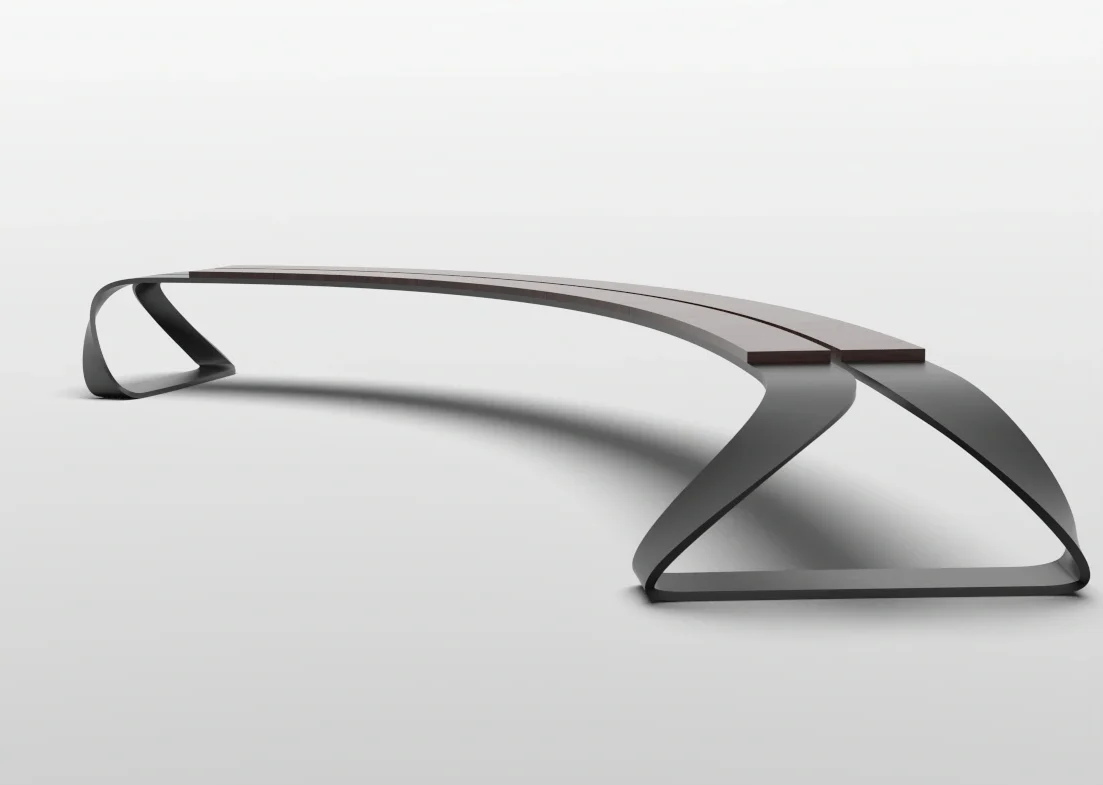
It was not a straight bench that had simply been bent. It was a rejection of the assumption that a bench must be straight.
It was designed for a forest, but it was also designed around human behaviour: around the need to turn, to look at one another, to speak and to share a place rather than merely occupy it.
It began with John’s phone call. It was drawn while a boat crossed the sea. And before that boat reached Ithaca, a simple letter had become a bench — a continuous form shaped by nature, frustration and the belief that design should not merely give people somewhere to sit.
It should not merely give people somewhere to sit.
It should change the way they sit together.
— Harry Konstantinou, IDEA34